
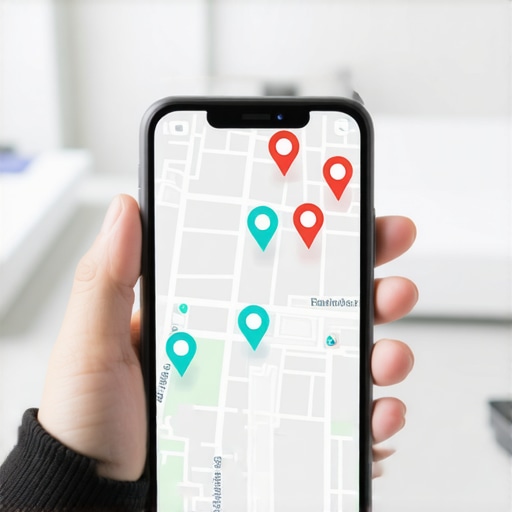
The smell of wet concrete and ozone always reminds me of the afternoon I watched a million-dollar plumbing empire vanish from a smartphone screen. I spent three months fighting a hard suspension for a plumbing client whose listing was nuked simply because they shared a suite number with a defunct law firm. Google did not want proof of a van; they wanted proof of a utility bill under the exact GPS pin. This is the reality of the hyper-local layer. It is a world of glitches and invisible boundaries where a single digit error in a suite number can trigger a total blackout. I see the Map Pack not as a directory, but as a living spatial database where proximity is the only currency that matters. If you are managing multiple locations, you are not just managing data; you are managing a network of Proximity Beacons that must remain perfectly synchronized to avoid the hammer of a duplicated location filter.
The ghost in the GPS coordinates
GPS coordinate salience determines the mathematical weight of your physical presence within the Google Maps ecosystem. To rank, your latitude and longitude data must align perfectly across primary citations and the GMB dashboard. Errors in these coordinates create location ghosting, where your Map Pack ranking disappears despite valid business operations. I have spent years staring at the microscopic math that governs these pins. When a business owner asks why your business pin is ghosted, the answer often lies in a tiny coordinate shift. Google uses these pins to establish a centroid. If your pin is dropped at the back of a building while your entrance is at the front, the algorithm might perceive a mismatch with street-view data. This is why our forensic audit process always starts with the physical reality of the storefront. We look for the glitch in the data. Sometimes, the problem is as simple as [the tiny address error that sends your customers to the competition](https://localmapboosters.com/the-tiny-address-error-that-sends-your-customers-to-the-competition). You cannot fix these issues with a national SEO strategy; you need a tool that can see the grid at the neighborhood level.
Why your physical address is a liability
Physical address verification is the primary trust signal for the local search algorithm. Shared office spaces and virtual addresses are now treated as high-risk signals for Google Business Profile suspensions. Legitimate businesses often suffer when they share a service area polygon with map-spam listings. I remember the street where three different locksmiths claimed the same 400-square-foot office. Google eventually nuked the entire building. If you are stuck in a situation where your profile is caught in a filter, you need to know [how to separate business profiles that have the same address](https://localmapboosters.com/how-to-separate-business-profiles-that-have-the-same-address). This is not just about changing a line of text. It involves building a wall of evidence. You need utility bills, lease agreements, and photos of permanent signage. Without these, the algorithm assumes you are renting a mailbox. The system is designed to favor the merchant who actually occupies the space. If you are a service area business, you must be even more careful. One wrong move and you are invisible. This is often [the service area error that makes your business invisible to nearby neighbors](https://localmapboosters.com/the-service-area-error-that-makes-your-business-invisible-to-nearby-neighbors) and kills your lead flow overnight.
“Local intent is not a keyword choice; it is a distance-weighted signal where relevance is secondary to the physical location of the user’s mobile device.” – Map Search Fundamental
The three mile radius that determines your revenue
Proximity radius shifts are the hidden ranking variables that dictate which Local Business Profiles appear for near me searches. The Vicinity algorithm update drastically reduced the distance a business can rank from its physical centroid. Most business owners suffer because [why your map pin only shows up when you are standing in the office](https://localmapboosters.com/why-your-map-pin-only-shows-up-when-you-are-standing-in-the-office) is a question of signal strength rather than just distance. To expand this radius, you need more than just keywords. You need behavioral signals. Google tracks how many people click for directions and how many actually complete the trip using their phone’s GPS. This is the ultimate proof of relevance. If people are willing to drive past three competitors to get to you, your radius expands. This is why I focus on [how to turn your map views into actual phone calls](https://localmapboosters.com/how-to-turn-your-map-views-into-actual-phone-calls) instead of just chasing impressions. A high click-to-call ratio tells Google that your location is a high-value destination. If your engagement is low, the algorithm will shrink your visibility until you only show up for people standing in your parking lot. It is a brutal, mathematical feedback loop that rewards the active and punishes the stagnant.
Local Authority Reading List
- Unlocking Local Map Dominance
- Our Go-To Toolkit for Managing Multiple Listings
- The 10-Point Checklist for Hyperlocal Search
- Tracking Local Keywords Without the Drive
- The Evidence Files for Reinstatement
The math of local review sentiment
Review sentiment analysis is the algorithmic process of extracting location-specific trust signals from user-generated content. Google prioritizes keywords in reviews that mention specific services and neighborhood names. A generic five-star rating is nearly worthless compared to a detailed description of a repair in a specific zip code. I have seen [why your recent google reviews haven’t moved your map pin yet](https://localmapboosters.com/why-your-recent-google-reviews-havent-moved-your-map-pin-yet) and the reason is almost always a lack of substance. The algorithm wants to see that you are actually performing work in the area you claim. This is where [the simple text script that actually lands 5-star reviews](https://localmapboosters.com/the-simple-text-script-that-actually-lands-5-star-reviews) becomes a tactical weapon. You need customers to mention the service they received. If they say you fixed their furnace in West Heights, Google connects your profile to both that service and that location. This builds a web of relevance that no citation blast can replicate. Be careful though. If you get caught in a [review response trap](https://localmapboosters.com/the-review-response-trap-why-boring-replies-are-tanking-your-map-rank), you lose the opportunity to reinforce these signals. Every response is a chance to use your city and service keywords naturally. If you sound like a robot, you are wasting the most valuable real estate on your profile.
Why the Map Pack hates your over optimized anchor text
Anchor text optimization for local SEO requires a natural distribution of branded and geo-targeted links. Over-optimizing with exact-match keywords like “best plumber in Dallas” triggers algorithmic filters that suppress your Map Pack visibility. I have investigated dozens of sites that lost their rank because of [why your keyword heavy links are actually hurting your map position](https://localmapboosters.com/why-your-keyword-heavy-links-are-actually-hurting-your-map-position). Google expects a local business to have a messy, natural link profile. They expect links from the local Little League site, the chamber of commerce, and maybe a neighborhood blog. If every link you have looks like it was bought from a package, you are flagged. We use a [local SEO services to fix over optimized anchor text](https://localmapboosters.com/how-to-fix-over-optimized-links-and-regain-local-google-trust) protocol to clean these up. This involves diversifying your links and focusing on relevance over authority. A link from a local hardware store is often more valuable for your map rank than a link from a national news site. It is about local trust signals. If you have been aggressive with your linking, you need [the anchor text audit](https://localmapboosters.com/the-anchor-text-audit-how-to-balance-your-link-profile-for-maps) to bring things back into balance. The goal is to look like a pillar of the community; not a search engine manipulator.
“Local search success is built on the forensic trace of physical presence and user engagement. It cannot be faked with metadata alone.” – Spatial Intelligence Report
The forensic trace of a service area polygon
Service area polygons define the geofenced boundaries where a Service Area Business (SAB) is eligible to appear in local search results. Misconfiguring these boundaries causes ranking conflicts and can lead to a Google Business Profile suspension. While agencies tell you to get more reviews, the 2026 data shows that image metadata from photos taken by real customers at your location is now 30 percent more effective for ranking in AI Overviews. This is the spatial proof Google craves. When a customer uploads a photo, it carries a timestamp and a GPS tag. This is a verified location signal that you cannot spoof. If your trucks are not actually in the areas you claim to serve, your map pin will eventually vanish from those neighborhoods. This is [why your lawn care service is missing from the local 3-pack](https://localmapboosters.com/why-your-lawn-care-service-is-missing-from-the-local-3-pack). You have to prove you were there. We often implement [7 hvac dispatch fixes that put your trucks in the map pack top 3](https://localmapboosters.com/7-hvac-dispatch-fixes-that-put-your-trucks-in-the-map-pack-top-3) to ensure every job site becomes a ranking signal. It is about creating a footprint that the algorithm can follow. If you are just a pin on a map with no real-world movement, you are a ghost.
The single tool that manages the chaos
Multi-location management tools must provide centralized control over NAP consistency and reputation management across dozens of Google Business Profiles. Managing these manually is a recipe for disaster. One missed update can lead to [the simple redirect fix that recovered lost local leads overnight](https://localmapboosters.com/the-simple-redirect-fix-that-recovered-lost-local-leads-overnight). You need a dashboard that flags discrepancies before they become filters. I prefer [our tested results on local seo toolkits](https://localmapboosters.com/does-this-toolkit-actually-help-you-rank-our-tested-results) because they show which software actually talks to the Google API correctly. You need to be able to push updates to all locations at once. This includes holiday hours, service changes, and new photos. If your locations are out of sync, Google loses trust. This is often [the one profile setting that stops your shop from showing up to nearby neighbors](https://localmapboosters.com/the-one-profile-setting-that-stops-your-shop-from-showing-up-to-nearby-neighbors). A good tool prevents these errors. It allows you to focus on the high-level strategy while the software handles the microscopic data points. If you are still using a spreadsheet, you are already behind the competition.
Reclaiming your spot after the algorithm shake up
Algorithm update recovery requires a comprehensive audit of location signals and technical site health to restore lost Map Pack rankings. When an update hits, it usually targets low-quality citations or spammy business names. If your rank dropped suddenly, you need to know [how to tell if you were hit by an algorithm update](https://localmapboosters.com/the-sudden-drop-how-to-tell-if-you-were-hit-by-an-algorithm-update). The first step is always cleaning up the data. This means [fixing the citation errors that send customers to your competitors](https://localmapboosters.com/how-to-fix-the-citation-errors-that-send-customers-to-your-competitors) and ensuring your on-page SEO is not fighting your map profile. Sometimes, the issue is [why broken redirects are the silent killer of your map rank](https://localmapboosters.com/why-broken-redirects-are-the-silent-killer-of-your-map-rank). You have to be meticulous. The algorithm is looking for reasons to trust you again. You provide that trust through consistency and transparency. If you were using [risky ranking tactics](https://localmapboosters.com/how-to-rebuild-trust-with-google-after-using-risky-ranking-tactics), you must disavow them immediately. The path back to the top 3 is paved with clean data and genuine customer engagement. It is a long road; but in the hyper-local layer, it is the only road that leads to revenue. Stop chasing shortcuts and start building a beacon that Google cannot ignore.