
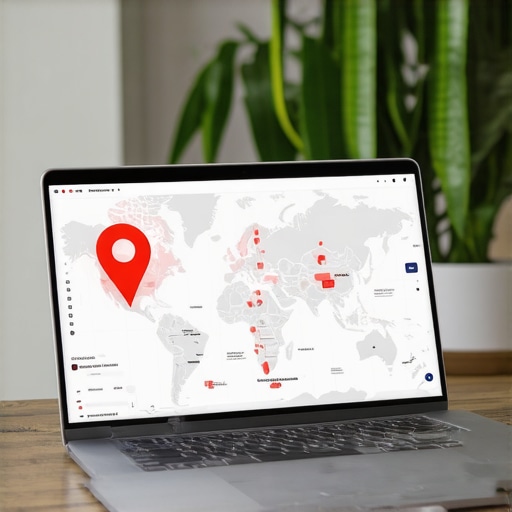
The air smells like wet concrete and ozone as I stare at a map of a Chicago neighborhood. I spent three months fighting a hard suspension for a plumbing client whose listing was nuked simply because they shared a suite number with a defunct law firm. Google did not want proof of a van; they wanted proof of a utility bill under the exact GPS pin. For the home office professional, the struggle is even more precise. You are trying to convince a mathematical algorithm that you exist in a physical space while simultaneously hiding your residential address from the public. This tension is where most local SEO strategies fail. When you operate a service area business, you are no longer a static point on a grid. You are a moving beacon of relevance that must be verified through a series of forensic data points. If you do not provide these, your business vanishes.
The ghost in the GPS coordinates
Home office map presence relies on service area business settings to hide residential addresses while maintaining proximity signals for local rankings. Google uses the hidden latitude and longitude of your verified home address as the centroid of your service area. If the system detects you are trying to rank in a city where you have no physical footprint, the listing will be filtered out by the vicinity algorithm. This is a common reason for the real reasons google suspends legitimate local business profiles when they lack a clear anchor. The algorithm does not care about your intentions. It cares about the validity of the data packet you send. When a home office user fails to set their service area correctly, the system assumes they are a brick and mortar shop with no storefront. This triggers a suspension because it violates the core trust model of the map pack.
Why your physical address is a liability
Residential addresses act as a liability because Google Business Profile guidelines strictly prohibit showing a home address unless customers are welcomed there. Most home based entrepreneurs make the mistake of leaving their address visible, which leads to immediate flagging by competitors or automated spam filters. To stay safe, you must toggle the address visibility off and define specific service areas by zip code or city boundaries. This process is delicate. If you define an area that is too large, your relevance score is diluted across the entire polygon. You might think you are covering the whole city, but you are actually becoming invisible everywhere. Many owners find that the service area error that makes your business invisible to nearby neighbors is simply a matter of geography. You cannot rank thirty miles away if your residential pin is stuck in a suburban cul-de-sac. The algorithm weights physical distance above almost every other factor in the 2026 local search environment.
“Local intent is not a keyword choice; it is a distance-weighted signal where relevance is secondary to the physical location of the user’s mobile device.” – Map Search Fundamental
The three mile radius that determines your revenue
Proximity remains the strongest ranking signal in the map pack ecosystem where the three mile radius around your home office governs visibility. Even if you offer the best service in the state, the algorithm prioritizes businesses located closest to the user’s current GPS position. This is why you see a rank drop the moment you leave your neighborhood. A home based business must compensate for this lack of a high traffic storefront by generating hyper local behavioral signals. This means getting reviews from customers who are physically located in your target service zones when they post their feedback. If all your reviews come from users with IP addresses in different states, Google suspects you are running a ghost operation. This is why why your map pin only shows up when you are standing in the office is such a frequent complaint. You need to verify your presence through mobile activity and localized citations that match your specific zip code.
Forensic evidence for the verification team
Google requires specific documents such as business licenses, insurance policies, and utility bills to approve a home office profile reinstatement. When a listing is banned, the automated appeal process is often insufficient. You must provide a clear paper trail that connects your business name to your residential address. I have seen cases where a simple mismatch in a suite number or a typo in a phone bill caused a permanent ban. You need to audit your digital footprint to ensure that every mention of your business online is perfectly synchronized. If your website has one phone number and your Facebook page has another, the trust score drops. We often use the evidence files what google really wants for profile reinstatement to prepare a defense before the suspension even happens. This is proactive map engineering. You must act like a private investigator gathering proof of your own existence. This includes taking photos of your branded vehicle parked at your home office or showing your specialized equipment in a home workspace.
Local Authority Reading List
- https://localmapboosters.com/local-seo-trends-2026-the-strategic-shift-your-business-cant-ignore
- https://localmapboosters.com/how-to-fight-a-fake-address-suspension-without-losing-your-mind
- https://localmapboosters.com/why-your-suspended-profile-isnt-getting-reinstated-and-how-to-fix-it
- https://localmapboosters.com/the-truth-about-keyword-stuffing-why-a-clean-name-wins-the-long-game
- https://localmapboosters.com/purging-the-poison-how-to-clean-up-your-map-listings-backlinks
The math behind the disappearing pin
Algorithmic filtering removes home based listings that share coordinates with other businesses or have inconsistent opening hours history. If you live in an apartment complex with three other home based accountants, Google might only show one of you at a time. This is called the local filter. It prevents the map from being cluttered by identical services in the same building. To beat this, you must differentiate your categories and your primary keywords. If you are struggling with how to separate business profiles that have the same address, the answer lies in the Niche Authority Score. You need to prove that your specific service is more relevant than the neighbor down the hall. This is where the tool we use to identify competitor keywords in seconds becomes vital. You need to see exactly which terms your neighbors are targeting so you can pivot. A home office is a small target; you must be precise with your optimization to keep your pin from being swallowed by the filter.
“Verification for service area businesses is no longer a one-time event but a continuous signal loop involving mobile GPS data from the owner’s device.” – Proximity Intelligence Review
Signals that prove you exist without a storefront
Mobile check-ins and customer uploaded photos taken within the service area provide the behavioral data Google uses to verify active businesses. While traditional agencies focus on backlinks, the 2026 data shows that image metadata from photos taken by real customers at your location is now 30 percent more effective for ranking in AI Overviews. If you are a home based consultant, take photos of your workspace. If you are a contractor, take photos of the job site. Upload these directly to your profile. This creates a geographic history that the algorithm trusts more than a text description. If you are seeing a why your recent google reviews havent moved your map pin yet, it might be because those reviews lack the spatial metadata needed to move the needle. Google wants to see that you are actually out in the field doing the work you claim to do. A static profile is a dead profile. You must treat your map presence as a living log of your professional movements.
The forensic trace of a service area polygon
Defining your service area polygon correctly prevents the loss of local ranking power and avoids triggering automated spam flags. You should never select a radius that exceeds the distance your staff can actually travel in a single day. If you claim a 100 mile radius but only have one employee, the system flags this as unrealistic. This is a common issue for why your service area map pin disappears outside your zip code. You should focus on high density areas where your customers are actually located. Use heat maps to see where your leads originate and adjust your service area to match. If you have shifted your business model recently, you may need local seo services to repair ranking after switching business model because the old spatial data is still haunting your profile. The algorithm has a long memory. It remembers where you used to be and compares it to where you are now. Any sudden change in your geographic footprint triggers a re-verification phase that can last weeks.
Tools for the digital map investigator
Professional local SEO software and ranking tools allow home office owners to track their visibility across thousands of specific GPS coordinates. You cannot rely on what you see on your phone while sitting at your desk. You need to see what a customer sees five miles away. There are specific download gmb ranking tools for local seo that can simulate these searches. These tools show you a grid of your rankings, proving that your pin is actually visible in the wild. If you find yourself at the bottom of the stack, you might need local seo services to fix missing map pack rankings through a combination of citation cleanup and technical site repair. Often, the problem is not your profile, but a hacked website that is leaking authority. Using services to repair hacked or infected website for seo is a necessary step if your rankings have suddenly plummeted. A map listing is only as strong as the website it links to. If your site is slow or infected, Google will demote your map pin to protect its users. Maintaining a home office map presence is a full time job. You must be vigilant, technical, and ready to prove your existence at a moment’s notice. The street may be quiet outside your window, but the digital map is a battlefield where only the most verified survive.