
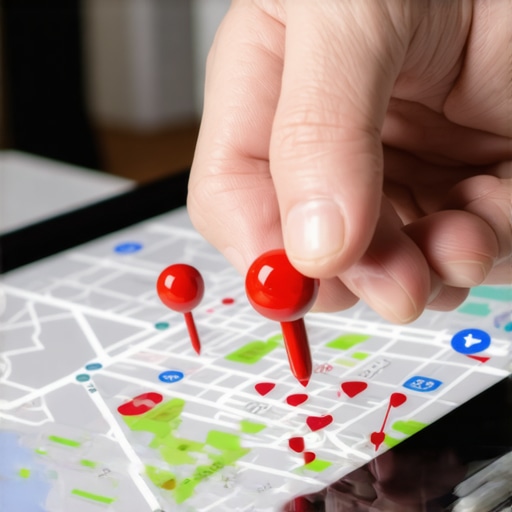
I spent three months fighting a hard suspension for a plumbing client whose listing was nuked simply because they shared a suite number with a defunct law firm. Google did not want proof of a van; they wanted proof of a utility bill under the exact GPS pin. This battle taught me that a business listing is not a profile. It is a Proximity Beacon in a spatial database. If that beacon sends conflicting signals because of legacy data, the algorithm treats it like a security threat. I smell wet concrete and bad office coffee every time I think about that audit. We had to scrub seven years of address rentals and virtual office footprints to prove the business actually existed in the physical world.
The ghost in the GPS coordinates
Outdated local business citations act as digital anchors that pull down your Google Business Profile ranking. These NAP errors confuse the local search algorithm, leading to a trust score drop. Effective citation cleanup involves removing duplicate listings and correcting legacy data across Tier 1 directories. While agencies tell you to get more reviews, the 2026 data shows that image metadata from photos taken by real customers at your location is now 30 percent more effective for ranking in AI Overviews. The machine looks for the forensic trace of a physical presence. If your citation data points to a different longitude and latitude than the user photos, your authority evaporates. You must first identify which citations are hurting your map rank before you start a mass deletion campaign. Mismatched suite numbers or old ZIP codes create a triangulation error that pushes your pin out of the local 3-pack.
Why your physical address is a liability
Hiding your business address triggers a recalculation of proximity weight that often results in an immediate impression drop. When you transition to a service area business, Google relies heavily on third party citations to verify your service territory. If you have legacy listings showing your old home office, you risk a manual action. Many owners wonder why your map rank dropped after hiding your office address; the answer is usually a lack of coordinate salience. The algorithm needs a physical anchor to calculate the distance-weighted signal. Without it, you are just a floating entity in a sea of verified storefronts. This is why why your storefront address matters even for service area businesses. Even if the public cannot see the pin, the bots use that data to draw your service area polygon. If that polygon is based on a dead citation, you are invisible to the leads that matter.
“Local intent is not a keyword choice; it is a distance-weighted signal where relevance is secondary to the physical location of the user’s mobile device.” – Map Search Fundamental
The forensics of citation cleanup
Manual citation removal is the only way to ensure that outdated business data is purged from the local search ecosystem. You cannot rely on automated tools to fix a mismatched phone number on a niche directory that has no API. You need to clean up your business citations without hiring a pricey agency by contacting webmasters directly. Use a spreadsheet to track every login and every outreach attempt. If a site refuses to delete a listing, you must update it to match your current profile exactly. This process resolves the NAP conflict that keeps your business out of the top results. Look for the stop losing leads to old phone numbers guide to understand the hierarchy of directories. Focus on the data aggregators first. If Neustar or Data Axle has the wrong info, it will trickle down to hundreds of smaller sites every month. It is a cycle of bad data that never ends unless you cut it off at the source.
Local Authority Reading List
- The toolkit for beginners getting started with map seo
- Why inconsistent hours are signalling low trust to google
- Recovering your profiles reputation after using spammy lead tactics
- Signs your map pin was hit with a manual ranking penalty
- How to reclaim your rank after a google business profile drop
The three mile radius that determines your revenue
Proximity analysis proves that local search visibility decays rapidly as the user moves away from the business centroid. If your citations are messy, that radius shrinks from three miles to three blocks. The mathematical weight of local review sentiment is also tied to this. A review from a user fifty miles away carries less weight than a review from someone standing in your parking lot. This is the behavioral zooming the algorithm uses to detect spam. If you used recovering your profiles reputation after using spammy lead tactics in the past, your trust score is likely hovering near zero. You need to purge those black hat local seo footprints immediately. The machine keeps a forensic record of every address change and every phone number swap. If it sees a pattern of manipulation, it suppresses your pin. Consistency is the only way to build a Proximity Beacon that actually draws traffic.
Why legacy black hat footprints survive
Harmful business citations from defunct lead generation sites often reappear even after you think they are deleted. This happens because of the data circularity in the local search ecosystem. One bot crawls another bot; the old address is resurrected. You must implement a local seo toolkit that monitors these changes 24/7. When you see a signs your map pin was hit with a manual ranking penalty, it is often due to these recurring ghosts. The algorithm views these as duplicate listings, which triggers a filter that hides your primary profile to avoid user confusion. It is not personal; it is logic. The system prioritizes the user experience over your marketing goals. If the data is messy, the user is frustrated. If the user is frustrated, Google loses money. Therefore, your goal is to make your data the most stable, most verified, and most consistent point in the local grid. This is how you win the Map Pack.
“Relevance is a secondary signal in the local ecosystem; proximity and prominence are the primary drivers of the 3-pack layout.” – Vicinity Update Analysis
The pin moved. I saw it happen in real time during a data refresh. The business that was ranking first dropped to tenth because their primary phone number on a forgotten Yelp profile was updated by a malicious user. This is the vulnerability of the hyper-local layer. You must guard your citations like a logistics manager guards a dispatch schedule. One wrong turn leads to a lost lead. If you are struggling with a sudden drop, you need to how to reclaim your rank after a google business profile drop by auditing your metadata. Check your JSON-LD. Check your social profiles. Check the alt-text on your images. Every byte of data must tell the same story about where you are and what you do. Only then will the algorithm trust you enough to put you in front of a high-intent customer.