
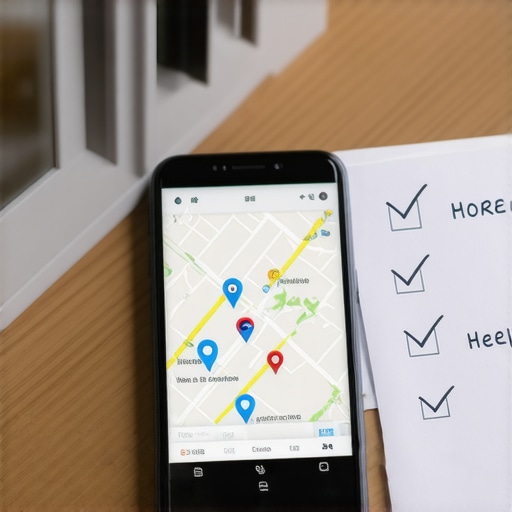
The simple map ranking checklist every small business owner needs
I spent three months fighting a hard suspension for a plumbing client whose listing was nuked simply because they shared a suite number with a defunct law firm. Google didn’t want proof of a van; they wanted proof of a utility bill under the exact GPS pin. This is the reality of the hyper-local layer. You are not managing a profile; you are maintaining a proximity beacon in a mathematical spatial database. If your beacon flickers or shares a frequency with a ghost, the system shuts you down. This logistics-first approach is the only way to survive the Map Pack ecosystem in an era of aggressive automated enforcement.
The three mile radius that determines your revenue
A Google Business Profile ranks based on proximity, relevance, and prominence, with physical distance being the primary filter for most local service queries. To dominate the three-mile radius around your office, you must ensure your GPS coordinates align perfectly with your verified service area and your historical citation data. The algorithm operates like a dispatch system. It wants to send a user to the closest, most reliable point of service. If you are trying to rank for a keyword ten miles away without a physical presence there, you are fighting physics. This is why why your storefront address matters even for service area businesses is a vital concept for every contractor to understand. The pin is the center of your universe; every mile you move away from it, your visibility decays by a predictable percentage unless your prominence signals are extraordinary.
“Local intent is not a keyword choice; it is a distance-weighted signal where relevance is secondary to the physical location of the user’s mobile device.” – Map Search Fundamental
The forensic trace of your business history
Cleaning up your digital history is mandatory because Google retains a memory of every address, phone number, and name ever associated with your brand. Inconsistent data from a decade ago can still trigger a trust drop today, leading to stagnant rankings or sudden manual penalties. You must perform a deep audit of your legacy data. If you have moved locations or changed business names to chase keywords, you have likely left a trail of toxic metadata. Most owners fail to realize that scrubbing legacy spam from your business profile history is the only way to reset the trust score. When the algorithm sees three different phone numbers for the same brand across the web, it loses confidence. It will then demote you in favor of a competitor with a cleaner record. This is especially true for those needing seo services to normalize rankings after keyword stuffed business name edit attempts that went wrong.
Why your physical address is a liability
Hidden addresses often suffer from a visibility ceiling because Google prioritizes businesses with a verified, public storefront over residential service area businesses. While you can hide your address for privacy, doing so often triggers a significant drop in impressions for hyper-local search terms. The system treats a public office as a higher-trust entity. If you recently toggled your profile to a service area only model, you probably saw a dip. You need to understand why your map rank dropped after hiding your office address before you make permanent changes. The math of the Map Pack favors the permanent structure. If you are residential, your photos must prove you are a legitimate operation. Use the toolkit for beginners getting started with map seo to document your gear, your branded trucks, and your team in the field to compensate for the lack of a public lobby.
Local Authority Reading List
- The audit checklist that finds hidden map visibility killers
- How to identify which citations are hurting your map rank
- Recovering lost traffic when your business address goes private
- How to recover traffic after your address was hidden for privacy
- The hidden cost of ignoring broken links on your local landing pages
The mathematical weight of local review sentiment
Review velocity and sentiment analysis are the two most powerful prominence signals after the proximity filter has been satisfied by the algorithm. High-frequency reviews containing specific service keywords and geographic markers tell Google that your business is active and relevant to the local community. It is not just about the star rating. The text of the review matters. When a customer mentions the city name and the specific service like water heater repair, they are providing a localized justification trigger. This is why how to rebuild map trust after a major listing cleanup involves a heavy focus on authentic customer feedback. Avoid the temptation of buying fake reviews. The AI can detect the linguistic patterns of non-local users. If the GPS data of the reviewer does not match your service area, the review may be filtered or, worse, trigger a manual investigation.
“Relevance in the Map Pack is determined by the intersection of user behavior patterns and the verified attributes of the business entity.” – Map Search Fundamental
The ghost in the GPS coordinates
Image metadata is now a primary signal for AI-driven local search overviews, as Google uses the EXIF data in photos to verify that your business actually operates where you claim. Photos taken by customers at your location provide an unshakeable proximity signal that text cannot replicate. Every time a customer uploads a photo of your storefront, the embedded latitude and longitude data acts as a verification ping. If you are using stock photos or images with stripped metadata, you are missing a massive ranking opportunity. This is a core part of the gmb optimization toolkit for service businesses. You should encourage your technicians to take photos of completed jobs, provided they have the location services enabled on their devices. This creates a heat map of activity that proves your service area polygons are real and not just a setting in your dashboard.
The seasonal risk of opening hours history
Inconsistent opening hours create a trust gap that can lead to a ranking bottleneck, as Google monitors how often you change your schedule and compares it to user reports. If your hours are frequently edited, the algorithm may flag the profile as unreliable or temporary. Many businesses fluctuate their hours during holidays or slow seasons without considering the long-term impact. You need to know how to audit your opening hours history for ranking bottlenecks. A profile that shows “closed” when a user is searching is effectively dead in the rankings for those hours. Furthermore, if Google detects that people are calling and not getting an answer despite your profile saying you are open, your prominence score will suffer. Clean language metadata and accurate scheduling are the bedrock of local trust. Ensure you are cleaning up old hours data to improve user trust scores regularly.
The simple ranking checklist for small business owners
A successful local map strategy requires a relentless focus on data hygiene, technical site health, and consistent behavioral signals from your customers. Follow these steps to ensure your profile is not being suppressed by avoidable errors or outdated information. This checklist is your operational manual. Use it once a month to ensure your proximity beacon remains strong. The pin moved because someone didn’t check the data. Don’t let that be you.
- Audit your NAP (Name, Address, Phone) across the top 50 aggregators. Use the exact steps to fix a mismatched phone number across citations if you find errors.
- Remove any keyword stuffing from your business name. If you have been penalized, look into seo services to fix keyword stuffing and content issues immediately.
- Verify your primary category is the most specific one available. Consult the specific categories google uses to group local businesses for the right match.
- Check for 404 errors on your linked website. See how to fix the 404 errors killing your map visibility to prevent ranking drops.
- Analyze your backlink profile for spam. If your link profile is messy, find seo services to fix toxic backlink profile before the next core update.
- Monitor for duplicate listings. Learn how to clean up duplicate listings for your small business to stop competing against yourself.
- Review your redirect strategy. Use the simple redirect fix that restored our local search visibility if your landing pages are slow.
- Optimize your image alt text and metadata for local intent.
- Respond to every review, positive or negative, within 24 hours.
- Post a weekly update to your profile with a high-quality, non-stock image.
The system is cold. It is a machine that processes location data and user behavior to predict the best result. If your data is messy, the machine will ignore you. If your links are broken, the machine will penalize you. You must maintain the integrity of your local listing with the same precision you use to maintain your fleet of vehicles. Rankings are not a gift; they are the result of a perfectly maintained data ecosystem.