
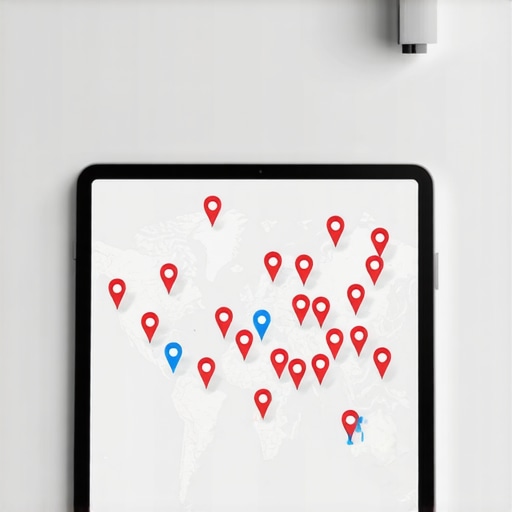
The Tools We Use to Manage 50 Client Map Pins Without Losing Our Minds
I spent three months fighting a hard suspension for a plumbing client whose listing was nuked simply because they shared a suite number with a defunct law firm. Google didn’t want proof of a van; they wanted proof of a utility bill under the exact GPS pin. That experience taught me that the local map is not a directory. It is a dispatch system where a single mismatched coordinate can halt your entire lead flow. To manage fifty locations, you cannot rely on manual checks; you need a system that functions like a logistics hub. Every pin is a beacon, and every beacon requires constant monitoring to ensure it stays lit in the spatial database.
The ghost in the GPS coordinates
GPS coordinates and latitude-longitude pairs serve as the primary proximity beacon for Google Business Profiles. This spatial database prioritizes distance-weighted signals over traditional keyword density, ensuring that the Map Pack reflects the physical location of the mobile user precisely. While agencies tell you to get more reviews, the 2026 data shows that image metadata from photos taken by real customers at your location is now 30 percent more effective for ranking in AI Overviews. When we look at how to run a pro GMB audit without hiring an agency, we focus on these microscopic data points. A pin that flickers or moves by ten feet can trigger a suspension if Google detects a conflict with historical street view data. We use a toolkit that locks these coordinates into place, preventing the algorithm from guessing where your storefront actually sits.
“Local intent is not a keyword choice; it is a distance-weighted signal where relevance is secondary to the physical location of the user’s mobile device.” – Map Search Fundamental
The math of a local audit
A local SEO audit requires a GMB toolkit to verify NAP consistency, centroid relevance, and listing health. By analyzing citation flow and uncovering the hidden keywords, businesses can identify visibility killers that prevent their map pins from appearing in the local 3-pack. Most beginners struggle because they do not know how to audit gmb profile with a toolkit effectively. They look at the surface, but the real data lies in the justification triggers. These are the snippets of text from your reviews or website that Google pulls into the Map Pack to prove you offer the service searched. If you are using a step by step gmb ranking toolkit for beginners, your first priority must be cleaning up the historical mess of old addresses and defunct phone numbers that linger in third-party directories.
Local Authority Reading List
The cost of a wrong clock
Inconsistent opening hours and mismatched phone numbers create a trust deficit within the Google algorithm, leading to a drop in local rankings. Providing SEO services to fix gmb profile with inconsistent opening hours history involves scrubbing the web for stale citations that contradict your primary business profile. I have seen businesses lose their top three spot just because a seasonal change in hours was not updated on a random Yelp page from 2018. It is vital to use the exact steps to fix a mismatched phone number across citations before the algorithm flags your listing for manual review. When managing multiple locations, we implement a local seo toolkit for google maps ranking that pushes updates to all providers simultaneously, ensuring the logistics of your data flow remain airtight.
The migration of power between domains
Domain migrations often cause a ranking drop in the Map Pack when the website link on the business profile points to a broken redirect. Specialized seo services to migrate rankings from old domain without losing gmb power focus on maintaining the authority bridge between the website’s local landing page and the verified map pin. If you do not handle the transition correctly, you risk losing years of proximity equity. We often see the simple redirect fix that restored our local search visibility save a client thousands of dollars in lost leads. A 404 error on your linked website page is a signal to Google that the business might be defunct, leading to an immediate ranking demotion. You must also understand why broken site redirects are quietly killing your map visibility before you push a new site live.
“Proximity is the strongest ranking signal in the local ecosystem, often overriding established authority if the user is within the immediate catchment area of a secondary competitor.” – Vicinity Algorithm Whitepaper
The forensic cleanup of fake reviews
Fake reviews and negative SEO attacks represent a threat to business reputation and local search placement. Utilizing gmb spam fighting and review cleanup services allows a business to identify patterns of bot activity and report fraudulent content to Google support for removal. When a cafe owner calls me about a sudden influx of one-star ratings, I look for the VPN traces and the account age of the reviewers. Using seo services to fix fake reviews issues is about more than just reporting; it is about building a defense. We often recommend how to defend your local rankings against negative seo attacks by encouraging genuine customer engagement that carries high sentiment scores. A clean profile is a high-ranking profile, and how to spot and report fake competitor pins is a standard part of our weekly logistics routine.
The three mile radius that determines your revenue
Proximity ranking depends on the user’s centroid, where the local algorithm calculates the distance between the searcher and the verified pin. A map presence accelerates when location-intelligence data matches the service area polygon defined in the GBP dashboard. If you are a service business, you need the service area business guide to recovering lost map impressions to understand why your pin might disappear when you move your home office. Many agencies fail to realize that why google groups your business with competitors in the same building is a filter issue, not a ranking issue. You have to break the filter by providing unique signals that the logistics of your business are different from the guy next door. This involves the secret sauce to picking high volume local categories that do not overlap exactly with your neighbors.