
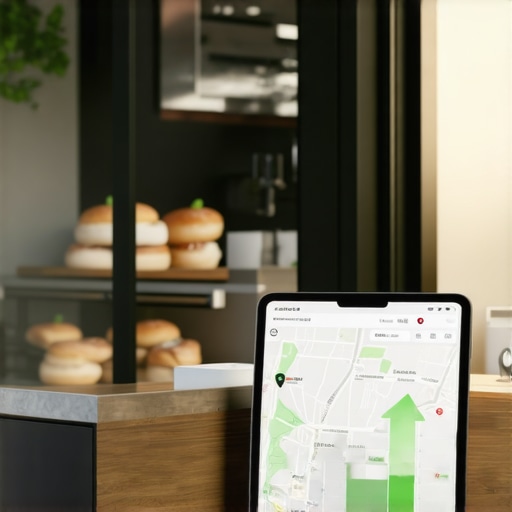
The air in my office always carries a faint scent of peppermint and the dust of old paper. I have spent decades defending the corner shop and the local plumber from the encroaching shadows of national conglomerates that pretend to be neighbors. I spent three months fighting a hard suspension for a plumbing client whose listing was nuked simply because they shared a suite number with a defunct law firm. Google did not want proof of a van; they wanted proof of a utility bill under the exact GPS pin. This is the reality of the hyper-local layer. It is a world of forensic spatial data where a single digit error in a suite number can trigger a total collapse of your digital presence. When your rankings drop, it is not just a glitch. It is a signal that the mathematical trust between your business and the local algorithm has fractured. We must look at the microscopic reality of these signals to understand how to fix them.
The ghost in the GPS coordinates
GPS coordinate salience and proximity weight are the primary filters that Google Business Profiles use to determine local search visibility within the Map Pack, meaning your business centroid must align perfectly with user intent and spatial database rules to maintain a top 3 ranking. The algorithm calculates the distance between the mobile device and your verified address down to the decimeter. If your pin is slightly off the actual building entrance, you are losing power. This microscopic math determines if you show up for a searcher standing three blocks away or two miles away. You can learn about why your map pin is stuck at the bottom of the pack to see how these tiny deviations manifest. The engine looks for the forensic trace of your service area polygon. It wants to see that your trucks are actually where you say they are. A mismatched phone number in a secondary verification tier is enough to kill the organic trust score. Every point of sale data integration point must reflect the same geographic truth. If it does not, you are a ghost in the machine. The algorithm treats you as a potential spam risk rather than a legitimate local merchant. I have seen rankings vanish overnight because of a single API update that shifted a business category slightly away from the core intent. You need to verify that your service area is not overlapping in a way that triggers duplicate filters.
“Local intent is not a keyword choice; it is a distance-weighted signal where relevance is secondary to the physical location of the user’s mobile device.” – Map Search Fundamental
Why your physical address is a liability
Google Business Profile suspensions often occur when address data conflicts with third-party citations or utility records, requiring a reinstatement strategy that focuses on proof of physical presence and NAP consistency across the local ecosystem. I despise when national chains use virtual offices to steal space from real local businesses. Google is aggressive about this now. If you share an address with another business, the engine might merge your data or flag you for removal. You must understand how to separate business profiles that have the same address to prevent these catastrophic merges. When you receive a suspension, the clock is ticking. You cannot guess. You need to provide the specific documents that prove you exist in that physical space. It is a grueling process of showing leases, tax licenses, and branded equipment. You can find the document checklist that gets your profile reinstated faster to save yourself from weeks of silence. The system views your address not as a location, but as a trust anchor. If that anchor slips, your entire search visibility sinks. This is why many service area businesses see their pins disappear the moment they hide their home address. You have to find a way to maintain the signal without violating privacy rules. It is a delicate balance of spatial engineering.
Local Authority Reading List
- Restoring Suspended Profiles Honestly
- Why Addresses Get Flagged
- Required Reinstatement Documents
- What to Do After Suspension
- Fixing Fake Address Disasters
The three mile radius that determines your revenue
Proximity based ranking drops are calculated using centroid theory, where local search rankings decay as the user distance increases from the business location, necessitating local SEO services that optimize for hyper-local relevance and geospatial authority. The pin moved. That is all it takes. In a competitive market, your three-mile radius is your lifeblood. Beyond that, the algorithm starts to favor competitors who are closer. To fight this, you must build high-authority signals that extend your reach. This involves spatial and behavioral zooming. You need to look at how customers interact with your profile when they are at the edge of your service area. Are they clicking the call button? Are they asking for directions? These signals tell Google that your relevance extends further than the physical math suggests. If you are struggling, look at the impression recovery plan for service area business owners for a deeper dive. The proximity radius is not a fixed circle. It is a fluid shape that expands and contracts based on real-world behavior. If your profile is getting clicks but zero calls, the algorithm will shrink your reach. It thinks you are not the right answer for those neighbors. You must understand why your business profile is getting clicks but zero phone calls to fix the leak. It often comes down to the engagement signals you are sending back to the mothership. High-quality photos taken at the customer’s location are now 30 percent more effective than standard reviews for maintaining that radius.
How to cleanse a toxic link profile
Toxic backlink removal for local SEO involves identifying spammy directories and low-quality anchor text that trigger manual actions or algorithmic suppressions, which requires disavowing harmful links to restore map pack authority and local trust. Most agencies sell citation blasts that are actually poison. They dump your NAP data into dead directories that no human ever visits. Google sees this. It knows those links are fake. You must begin purging the poison immediately. Look for anchor text that is too perfect. If every link to your site says “best plumber in New York,” the engine knows you are trying to game the system. You need a natural profile. Check why your anchor text strategy is keeping you off the front page to see what a healthy profile looks like. We recently had to do a forensic audit for a cafe owner who was hit by a competitor using a VPN to drop toxic links. We had to prove the patterns to the spam team. It is a war of attrition. You must filter out the junk to let the real signals breathe. A clean, small profile is always better than a massive, dirty one. Stop chasing impressions and start chasing authority.
“Consistency in local data is the foundation of trust; any deviation in NAP signals is interpreted as a lack of business stability by modern search algorithms.” – Google Business Profile Guidelines
Technical foundations that stop the ranking drop
Technical local SEO fixes for soft 404 errors and duplicate content ensure that search engine crawlers can index location pages accurately, preventing ranking drops caused by broken redirects or missing schema markup on the business website. The code matters. A single mismatched JSON-LD attribute for your LocalBusiness schema can make you invisible to voice search. If your site has ghost pages, the engine gets confused. You need to understand how duplicate content is hurting your map rank. Often, the problem is a simple redirect issue. We fixed a client’s site last month by identifying the simple redirect fix that recovered lost local leads overnight. Their old site was leaking authority because 404 errors were eating their local signals. You must realize that a 404 error is more than just a broken link; it is a sign of neglect. The local algorithm rewards active, healthy sites. It penalizes those that feel abandoned. Use a winning local SEO stack to monitor these technical details daily. If your site loads too slowly on a mobile device at a job site, you are losing the battle for the Map Pack. Fix the tiny code errors that are holding you back. It is the only way to claw your way back to the top and stay there. Stop the bleeding now. Restore the trust. Reclaim your neighborhood.